Before the Practice Log: How Apprentices Learned by Watching
See how learning by watching can sharpen a craft practice: follow a maker’s decisions, ask better questions and turn one observation into a useful trial.
A common mistake in learning by watching is to copy a craftsperson’s hand movements without understanding what prompted them. That can leave a beginner repeating a gesture in the wrong situation. A better approach is to follow the work from its starting conditions through the maker’s checks, then carry one observation into a manageable attempt.
What can learning by watching teach you?
Watching can reveal choices that are difficult to explain as a list of rules: when to pause, how to respond to a material, and what to inspect before continuing. It can also show the sequence around a technique, including how tools are prepared and how a finished section is checked.
This is a practical account of learning, not a claim that every historical apprenticeship followed the same pattern. Apprenticeship arrangements varied by place, period, trade and relationship between learner and teacher. The approach here applies to present-day craft learning and does not treat a single workshop scene as a universal historical record.
How do you follow a task rather than copy a gesture?
Begin by identifying the task’s purpose and the material being worked. Then watch what happens before, during and after a key action: what the maker notices, what they change, and how they decide whether to continue.
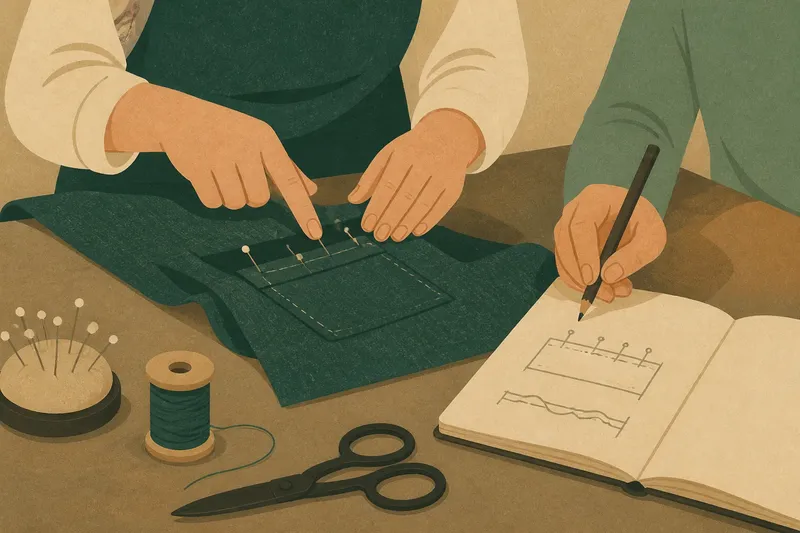
For example, at a sewing table, follow a pocket repair from aligning the torn edges to checking the seam. The important observation may be that the sewer pins the fabric flat before stitching and inspects the cloth for puckering afterwards. That connects a movement to its purpose and visible result.
How can you turn an observation into a useful practice session?
Use this sequence with a task that is safe for your skill level. Ask the maker before handling their tools or materials, and follow any relevant workshop safety instructions.
- Name the task and starting condition. Record what you are trying to make or repair and what the material looks like before work begins. If you cannot describe the starting point, ask for clarification before copying the process.
- Choose one decision to watch. Focus on a choice such as aligning fabric before stitching or checking a timber edge before cutting. If several actions compete for attention, follow just one and leave the others for another observation.
- Notice the cue and response. Watch for what the maker sees or feels before changing pressure, pace or direction. If the cue is unclear, ask about it at a natural pause rather than guessing.
- Watch the check. See how the maker judges the result, such as inspecting whether a seam lies flat. If the check reveals a problem, note what adjustment follows; if it looks acceptable, note what allows the work to continue.
- Try the same decision on a suitable task. Use materials and tools appropriate to your experience, and work under suitable supervision where needed. If the action is unsafe or beyond your ability, do not imitate it; ask for a safer demonstration or a simpler exercise.
- Compare the visible result with the intended one. Look for the feature you chose to observe, such as flat fabric or aligned edges. If it is present, keep the decision in your practice; if not, ask what adjustment to try next rather than changing several things at once.
Say you are repairing a pocket and have scrap fabric, a needle, thread and pins. At the demonstration, the sewer lays the torn edges flat, pins them, stitches with the cloth relaxed and checks the seam for puckering. You pin the edges of your own repair and stitch a short section; if the fabric gathers, you pause and ask whether tension or alignment needs attention, while a flat seam suggests you can continue with the same setup. The result gives you a specific question and decision, not a promise that the next section will behave identically.
What should you ask while someone is working?
What should I watch first when learning a craft?
Start with the task’s purpose, the material and the maker’s checks. Once you understand the overall sequence, choose one decision to follow closely.
When is a good time to ask a question?
Agree on a pause if possible, or ask after the immediate action is complete. A question tied to a visible moment, such as “What made you stop and check that edge?”, is easier to answer than a broad request for general advice.
Is learning by watching enough on its own?
No. Observation can clarify what to attend to, but a learner also needs appropriate opportunities to practise and receive guidance. Some techniques require supervision, particularly where tools or materials could cause harm.
What should I write in a practice log?
Record the cue, the decision and the result you could see, rather than writing only that the task felt difficult. For instance, note that you checked fabric alignment before stitching and whether the seam remained flat.
How does learning by watching differ from copying?
Copying repeats an action; learning by watching connects that action to a cue, a purpose and a check. This distinction matters when materials or conditions change, because a memorised gesture may no longer suit the task.
In a shared workshop, the learner can see tools being prepared and ask about a decision while the work is still in view. In a class or community makerspace, the same method can work through a demonstration followed by a supervised attempt. In either setting, respect the maker’s concentration and ask permission before touching their work.
For learning by watching to carry into practice, keep the next attempt narrow: use one observed decision, one relevant check and a result you can describe. That gives you a useful basis for the next question, even when the material responds differently than expected.