A Skill Becomes Easier to See When You Name Its Parts
Naming the parts of a skill helps you recognise what is already working and choose a manageable next area to explore, without judging yourself by the whole.
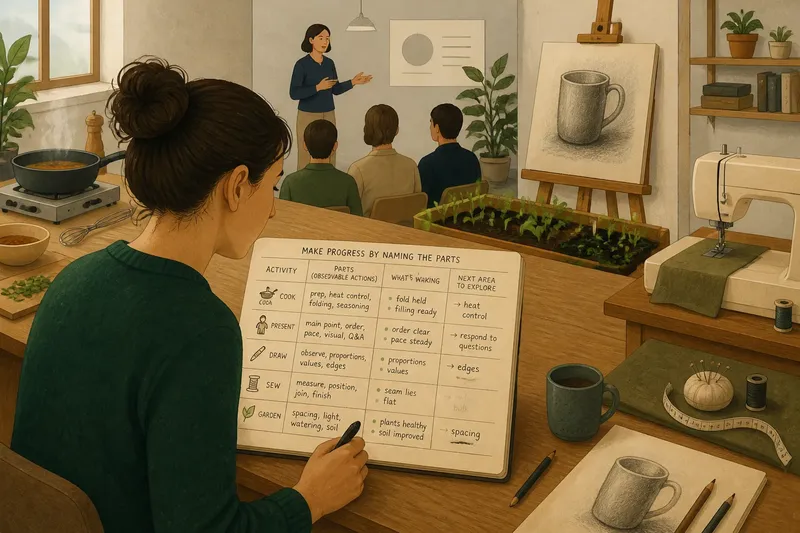
The common mistake in learning a skill is to judge the whole performance at once: “I’m bad at drawing,” “I can’t cook,” or “I’m not a natural speaker.” That broad verdict hides useful evidence. Naming the parts of a skill makes it easier to notice what is already working and choose a specific next area to explore.
What does it mean to break a skill into parts?
Breaking a skill into parts means describing the actions and decisions that make up an activity in terms you can observe. Instead of treating “playing the piano” as one ability, you might distinguish reading the notes, keeping a steady pulse, shaping a phrase and coordinating both hands.
These parts are not separate talents sealed off from one another. They interact, and the combination matters. The purpose of naming them is not to reduce a rich activity to a rigid formula; it is to give your attention somewhere more useful to land than on a sweeping judgement.
A helpful component is specific enough that you can recognise it in the work. “Be more creative” is too broad to observe directly. “Try two different layouts before settling on one” describes an action that can be seen and discussed.
Why can naming the parts reveal strengths?
A broad label tends to make every part of a performance seem equally successful or unsuccessful. Looking at components allows a more accurate picture: you may struggle to begin a task but be good at spotting an awkward detail, or find the opening of a talk uncomfortable while explaining a complicated idea clearly.
This matters because strengths are not always the most impressive-looking part of an activity. They can appear as reliable small choices: a baker notices when dough needs a gentler touch; a gardener spots that two plants compete for light; a writer knows which sentence sounds unlike the intended voice.
Notice what you can point to, rather than turning a single result into a claim about your character. “The explanation had a clear order” is more useful than “I’m a natural teacher”, because it identifies an action you can recognise again and build on.
How do you choose useful component skills?
Start with a particular task or moment, not the entire field. “Make a simple vegetable soup” gives you a more workable starting point than “become a better cook”; “draw a mug from observation” is more specific than “learn art”. Then describe the decisions that shape the result.
For a short presentation, the parts might include choosing a main point, arranging ideas, speaking at a pace listeners can follow, using a visual aid and responding to a question. For a charcoal sketch, you could look at observing proportions, placing the main shapes, controlling tonal changes and keeping edges clear.
Use plain verbs and avoid ranking the parts before you have considered them. A useful first map might be a short list on paper, with each item phrased as something a person could see or hear.
- “Select a clear main point” rather than “have confidence”.
- “Keep the rhythm steady through the change” rather than “be musical”.
- “Leave enough space between seedlings” rather than “have a green thumb”.
- “Check the seam lies flat” rather than “sew neatly”.
Different people may divide the same activity differently, and that is fine. Choose parts that help you understand the task you are doing; you do not need a complete inventory of everything an expert might consider.
How can you tell which parts are already working?
Look for observable signs in the finished work or while you are doing it. A clear transition in a piece of music, a readable label on a handmade jar, or a listener who can follow the order of an explanation gives you something more concrete than a feeling that the entire attempt was “good” or “bad”.
It also helps to separate intention from result. You may have meant to make a paragraph concise, but the visible evidence is whether the main point comes through without unnecessary detours. This distinction is not a reason to be harsh; it helps you describe what happened without guessing at your ability or effort.
Say you are learning to make a basic omelette and have identified preparation, heat control, folding and seasoning as parts of the task. Imagine that, after cooking, you notice the filling was ready before the eggs and the fold stayed intact, but the base browned more than you wanted. You could recognise the timing and folding as current strengths, then choose heat control as the next part to examine.
That example does not mean you must keep a formal scorecard. A quick note such as “fold held; base too dark” may be enough to make the result legible. The useful point is to preserve specific observations instead of letting the whole attempt collapse into “success” or “failure”.
Which part should you explore next?
Choose a component that matters to the task and that you can pay attention to without trying to change everything at once. A next area can be something that is not yet reliable, but it might also be a part you are curious about or one that would help the other parts work together.
For instance, if you are learning to sew and the finished item feels uncomfortable, the next question may not be how to make the stitching look neater. You might first explore how you measure and position the fabric, because that part affects how the garment sits. The decision should follow from what you can observe in your own work.
Keep the next area small enough to describe in ordinary language. “Make the join less bulky” gives you a clearer focus than “improve sewing”. You can still explore other components later; choosing one now simply keeps your attention from scattering.
How detailed should your skill map be?
Use as much detail as helps you see the task, but no more. If your list becomes a catalogue of tiny movements, it can be harder to recognise the overall activity. If it contains only broad qualities such as “talent” or “confidence”, it may not tell you what is actually happening.
A good test is whether you could point to an example of the component in a piece of work or a moment of action. If you cannot, make the wording more concrete. “Use a lighter touch on the brush at the edge” is easier to inspect than “improve technique”.
The map can change as your understanding changes. Early on, you might group several actions under “prepare materials”; later, you may find it useful to distinguish choosing the right paper from setting up the work surface. Add detail when it clarifies a real distinction, not simply because a longer list looks more thorough.
What questions help you name a skill’s parts?
Can one skill have different component maps?
Yes. A beginner learning to garden may focus on choosing a suitable spot, preparing soil and watering; someone with more experience may distinguish pruning decisions or how they combine plants. The map should fit the question you are trying to answer now.
What if a component is difficult to observe?
Look for a visible or audible consequence of it. “Planning” may be hard to see directly, but a sketch with clear labels or a recipe arranged in the order you will use it can show part of that planning.
Can a strength still need attention?
Yes. A part that already works can still be worth exploring if it interests you or helps the whole activity. Recognising it as a strength does not mean declaring it finished.
What if my list includes too many parts?
Group items that serve a similar purpose, then keep the ones that help you notice the task more clearly. If two items lead to the same observation, one may be enough for now.
How can naming parts support discovery without labelling yourself?
Think of a skill map as a description of an activity, not a verdict on the person doing it. “I can keep the rhythm steady” tells you something useful about a current ability; “I am musical” may feel encouraging, but it can also make a later difficulty feel like evidence against your identity.
When you name the parts of a skill, you give yourself room to be uneven. One component can be strong, another unfamiliar, and a third worth exploring simply because it draws your attention. That fuller picture makes the next question easier to ask: which part of this particular task do I want to understand better?
For any skill you are learning, try writing down a few observable parts before judging the result. The phrase “name the parts of a skill” is useful because it points to a modest but revealing habit: describe what you can see, recognise what is already working, and let that evidence guide what you explore next.