A Personal Exhibition from the Work You Almost Put Away
A personal exhibition of unfinished and finished work can reveal what to carry into your next project, without turning your season into a verdict.
The most common mistake in a personal exhibition is showing only the polished pieces. That can make a season of creative work look tidier than it felt, and it hides the abandoned turns, awkward trials and unfinished ideas that may point towards what you want to make next. A small display of unfinished and completed work offers a different kind of review: not a judgement of your ability, but a way to notice which questions have kept returning.
The aim is not to explain every object or defend every decision. Arrange a few pieces so that their contrasts are visible, then use those contrasts to form a useful question for your next project. If the display starts to feel like a retrospective of everything you have ever made, scale it back to one season, one room or one type of work.
Why does the exhibition feel like a verdict?
A display can feel exposing when it is treated as a ranking: finished work goes on the wall, unfinished work stays in a box, and the result is read as a record of success or failure. That arrangement gives completion too much authority. A piece may be finished because its question was answered, while another may be unfinished because its most interesting question is still open.
Start by choosing a modest boundary. It could be a season, a particular class, a stretch of evenings or a series of sketches made around one subject. Gather work from that boundary without sorting it into “good” and “bad”. Include an awkward draft, a study, a half-built object, a contact sheet, a test swatch or a page of notes if it helps show what you were trying to do.
Then decide what the display is for. If you want to understand where your attention went, include work that drew you back even when it was difficult. If you want to see how an idea changed, include an early attempt and a later version. A narrow purpose prevents the exhibition from becoming an all-purpose judgement on your creative life.
What if unfinished work looks too messy to display?
Unfinished work often feels messy because it was made to solve a problem, not to be presented. A rough drawing may carry construction lines; a knitted sample may have loose yarn ends; a draft of a song may contain crossed-out lyrics and a voice memo. Those marks are not necessarily defects to hide. They can show where a decision was still being tested.
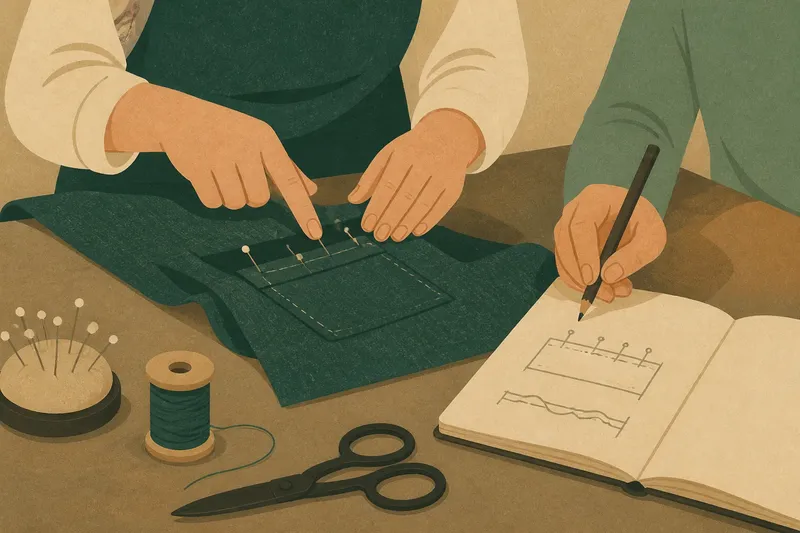
Make the work legible without making it falsely complete. Place loose pages in a folder or on a board, set a small object on a plain surface, or pair a digital file with a printed still and a short note about what remains unresolved. Keep the original condition visible where it matters: trimming away a failed section or rewriting a note for elegance can erase the clue you hoped to examine.
For work that is physically delicate, keep the display safe and brief, and use a photograph or scan if handling would risk damage. The point is to make a thoughtful arrangement, not to put every object on public view. A shelf, desk or pinboard can be enough; you can also make a private page in a notebook or a folder on your computer.
How do you choose pieces without favouring polished work?
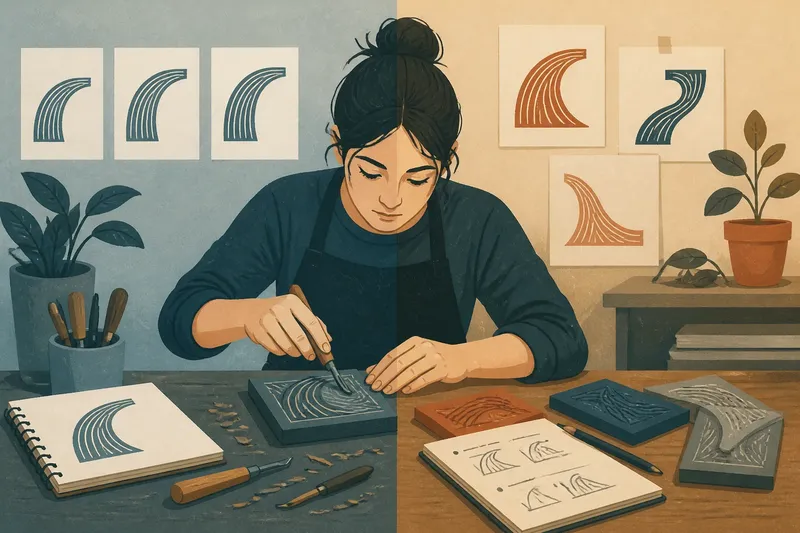
Choose by difference rather than by prestige. Look for a contrast that gives you something to notice: a piece made quickly beside one revised repeatedly, a confident passage beside a hesitant one, or a completed study beside a fragment that still has energy. The pieces do not need to be equally attractive or equally resolved.
Try collecting a small group under prompts such as these:
- A piece that surprised you while you were making it.
- A piece you stopped before you knew what it could become.
- A piece that reached an ending, even if the result feels modest.
- A repeated subject, material or gesture that appeared in more than one work.
- A decision you made quickly and one you kept postponing.
- A piece you would approach differently now, and the reason you would change course.
These prompts are not grades or categories to fill. If one does not fit your work, leave it aside. Choose enough material for the contrasts to show, but not so much that every item demands a long explanation.
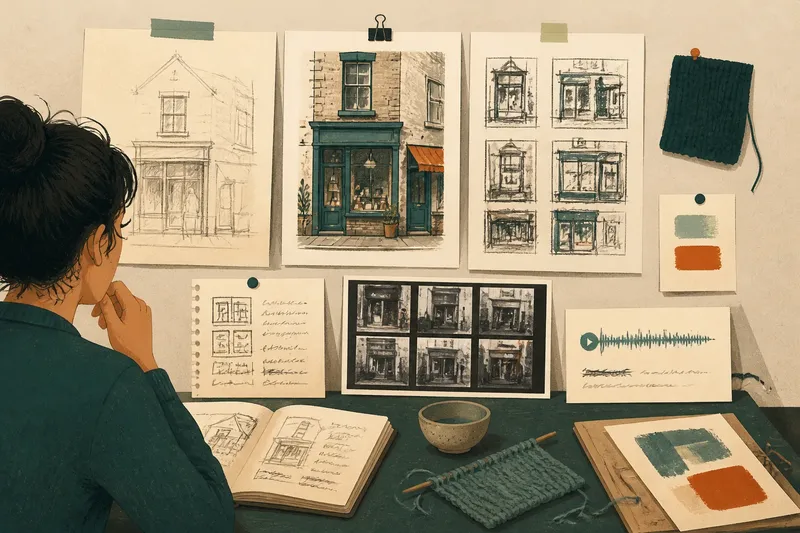
Imagine you have spent a season drawing neighbourhood shopfronts. You might display a finished ink drawing beside a pencil sketch you abandoned when the windows became difficult, and a page of small studies where you kept changing the angle. The visible contrast could suggest a next-project question: would you like to explore reflections, or is the pleasure in finding the right viewpoint? That question is more useful than deciding which drawing is the “best”.
What if the contrasts seem contradictory?
Contradiction is common in creative work. You may enjoy improvising in one piece and carefully planning another; you may be drawn to a material, then tire of it when a project becomes repetitive. A display does not need to resolve these differences into a single description of who you are.
Instead, ask what changed between the pieces. Was the subject different? Did you have a clear constraint in one case and open possibilities in another? Did you stop because the work had lost its pull, or because a practical interruption made continuing difficult? These are distinct situations, even if both leave an incomplete object behind.
Keep interpretation close to what you can see or remember. “I used fewer colours here” is an observation. “I am not a colour person” is a broader claim that one small group of works cannot support. If you find yourself making a sweeping judgement, return to the objects and name the specific choice or moment that prompted it.
What questions help you plan the next project?
How can I tell whether a fragment still interests me?
Look for the part you return to in memory or want to handle again, rather than asking whether the whole piece deserves completion. Note what draws you: a particular texture, problem, image or sound. If no part holds your attention, you can let the fragment remain evidence of an attempt rather than a project waiting to be rescued.
Should I finish an old piece before starting something new?
There is no universal rule that unfinished work must be completed. Consider whether finishing would answer a question you still care about, or whether a small experiment could teach you more directly. You can also set the piece aside deliberately, with a note about what would need to change before you return to it.
What if I cannot remember why I stopped?
Use the object itself as a prompt: inspect the last visible decision, the materials nearby or the point where the work changes direction. Write down what you can recall and mark uncertainty honestly. A tentative explanation is more useful than inventing a neat story about the work after the fact.
How do I turn an observation into a next-project question?
Convert a pattern into something you could explore without deciding the outcome in advance. If several pieces contain small repeated marks, ask what changes when repetition becomes the subject rather than a background detail. A good question opens a direction while leaving room for the work to surprise you.
How can the display stay reflective rather than performative?
A personal exhibition can be private. You do not need labels, an opening night or an audience unless sharing serves your purpose. If you do invite someone to look, tell them what kind of response would help, such as noticing recurring choices rather than judging which piece they prefer.
Use brief labels for context, not persuasion. A note might say, “Stopped here after trying three ways to join the pieces,” or “Made this after noticing the shadow changed in the afternoon.” Such notes preserve the circumstances that a viewer cannot infer, without turning the display into a defence of your decisions.
When you take the work down, keep a small record of the arrangement: a photograph, a sketch of where pieces sat or a page listing the questions you want to carry forward. Separate an observation from a decision. You might notice that you repeatedly changed scale, then decide to explore that possibility in a new work—or decide that another contrast matters more.
A personal exhibition of unfinished and finished work is useful when it helps you notice what you are curious about now. Let the display remain partial, and let the next question stay open enough to guide an experiment rather than dictate its result. The work you almost put away may not need a second life as the same project; it may simply show you where the next one could begin.